Tokyo Culture

This blog is all about Tokyo culture. You can find all sorts of infomation about things in Tokyo and the Tokyo culture here. Enjoy Tokyo and love Tokyo!
このブログは東京文化についてすべてです。 あらゆる種類の東京の情報と、東京の文化です。 東京を楽しむし、東京が大好き!!

Saturday, 31 January 2009

Eat in Tokyo: Japanese Snacks

Japanese snacks are know as sunakku kashi(スナック菓子) in Tokyo and Japan. Popular manufacturers include Meiji(明治), Morinaga(森永), Nissin(日清), Mikakuto(味覚糖), Yamasaki(山﨑), Calbee(カルビー,Karubī)...

Japanese snacks are tasty and diversified. Such as KitKat(キットカット, Kitto Katto) in Japan has over 20 different flavours, and with different packaging. Japanese snacks are best known for their taste, Japanese produce real delicacies. Japanese snacks usually come in many forms and flavours.

People in Tokyo usually eat snacks throughout the whole day. Snack shops grow everywhere in Tokyo. Popular snacks include:


Thursday, 29 January 2009

Live in Tokyo: Mobile Phones

In Tokyo, mobile phone culture is common. Mobile phones are called keitai denwa(携帯電話), or simply keitai. In May 2008, according to a media company in Tokyo, 31.3% of primary school students and 57.6% of secondary students in Tokyo own a mobile phone, most of which use their mobile phone to access the Internet, this contribute to the mobile phone culture in Tokyo.

Japanese manufacturers produce the most hi-tech and the most good-looking phones in the world, with leading technology that we can't find anywhere else in the world. Three of the most well-known phone retailers (often also as manufacturers) are Softbank, NTT, and au, which settle in Tokyo.

The new product of Softbank is Softbank 932SH, which is from Sharp. It features a 8.1-megapixel camera and a adjustable 3.3-inch LCD screen, and extended Internet browsing experience. Softbank 930CA is also another new product from Casio, which features a 8.1-megapixel camera and a 0.99sec capturing engine. The new product of NTT is NTT docomo SH-03A, which features mobile TV, GPS, and a 8-megapixel camera. It is one of the Japanese phones, so it looks good, with a rotating screen. The new product of au is the Sony Ericsson Premier3, it features a 3.2-megapixel camera and a nice look.

Softbank 932SH


Sony Ericsson Premier3

Monday, 5 January 2009

Eat in Tokyo: Japanese Desserts

Japanese desserts are called wagashi(和菓子) in Japanese. the most common ones are taifuku(大福), sakura mochi(桜餅, cherry blossom cakes), dorayaki(どら焼き, red bean pancake), warabi mochi(蕨餅, a jelly-like cake covered with flour).

Western confections are also gaining its popularity in Tokyo. Desserts succh as monburan(モンブラン, Mont Blanc), shōtokōki(ショートケーキ, shortcake), taruto(タルト, tart), aisukurīmu(アイスクリーム, ice-cream), kasutādo pudeingu(カスタードプディング, custard pudding), zerī(ゼリー, jelly), sufure(スフレ, Soufflé).

Thursday, 11 December 2008

Eat in Tokyo: Tea Ceremony

The Japanese ceremony, known as sadō (茶道) in Japanese, is a traditional way of having tea in Japan. In Tokyo, as it is new and cool for visitors, they will always try the tea ceremony.

Tea ceremony is a way of welcoming guests. It isn't just about drinking tea, it also involves a meal, a traditiona Japanese meal.

Before the guests enter, the teishu(亭主, host) fills a tsukubai(蹲踞, stone basin) with fresh water and then washes his hands and mouth. The guests are welcomed with a bow. Everyone remains silence. At the stone basin, the guests and host's assistant purify themselves and enter the teahouse through a sliding door that is just three feet high. To enter everyone has to bow, and this symbolises equal regardless of status or social position. The last person to enter puts the latch on the door.

In the tea ceremony, water represents yin(陰, the dark side), whilst the fire in the hearth represents yang(陽, the sun), as influenced by the Chinese. A jar called the mizusashi(水指) holds fresh water and symbolizes purity and only the host touches it. The green tea is called matcha(抹茶) in Japanese, and it is kept in a small ceramic container.

The host cleans the tea container and tea scoop with a fukusa (ふくさ, silk cloth). He fills the tea bowl with hot water and rinses the whisk. He then empties the tea bowl and wipes it with a tea towel. The host lifts the tea scoop and tea container and places three scoops of tea per guest into the tea bowl. Additional water is added to the paste until it is the consistency of cream soup, returning any unused water to the kettle. The host passes the tea bowl to the main guest first, and he will have to bow and accept it. The main guest admires the bowl by raising and rotating it. He then drinks some of the tea, wipes the rim of the bowl, and passes it to the next guest who does the same thing.

Wednesday, 10 December 2008

Live in Tokyo: J-Pop and J-Rock

J-pop and J-rock simply means Japanese pop and Japanese rock. They are both very popular in Tokyo. The music industry in Japan is of a large scale, and is the second largest music industry in the world, only behind the US.

J-pop is popular amongst all age groups - anime for youngsters, drama for adults, cartoons for children, etc. The most popular artists in Tokyo are EXILE, Fukuhara Miho, JUJU, Nakashima Mika, Mr. Children, B'z, GReeeen, Arashi... Their songs are found in Japanese animes, commercials, movies, TV shows, and video games.

J-pop has taken over many areas in the world, especially Asia, including Taiwan, Korea, Hong Kong... Pop artists are fashion leaders as well, what they do impacts the Japanese people.

Sunday, 7 December 2008

Live in Tokyo: Manga

Manga(漫画, comics) plays an important role in people's life in Japan. Whether you are a boy or a girl, you will surely read manga. Manga include a wide variety of subjects: action, romance, adventure, sports, fantasy, adult... Manga is particularly popular in Taiwan("manhua"), Korea("manhwa" and Hong Kong("manwa"). In other places in the world, manga is gaining its popularity, especially in France and in the US.

Manga firstly originates from the American cartoon, especially Disney. During the American occupation of Japan in WWII, mangas are created, influenced by the American culture. Astro Boy was then one of the most popular ones, and it still remains its popularity now. France was then deeply influenced by this Japanese culture in the 19th century, i.e. Japonisme.

Popular manga in Japan includes Bleach (ブリーチ), Death Note (デスノート), Detective Conan (名探偵 コナン), Doraemon (ドラえもん), Fullmetal Alchemist (鋼の錬金術師), Naruto (ナルト), One Piece (ワンピース), the Prince of Tennis (テニスの王子様), Yu-Gi-Oh! (遊☆戯☆王), etc.

Friday, 5 December 2008

Eat in Tokyo: Bentō

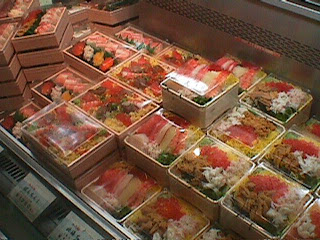
弁当(Bentō) is a takeout or home-packed meal common in Japan. Traditionally, it is a meal divided into two parts: one half of the box will be filled with rice, and the other half will be filled with a variety of accompanying foods, such as vegetables, fish, eggs, or meat. A well balanced bento will consist of rice to side dishes in a 1:1 ratio, and within the side dishes a 1:2 ratio of fish/meat to vegetables.

Containers are commonly disposable mass produced to hand crafted lacquerware. Although bento is readily available in many places throughout Japan, including convenience stores, 弁当屋(bentō-ya, bento house), train stations, and department stores, it is still common for Japanese homemakers to spend considerable time and energy producing an appealing boxed lunch.

Common side dishes can include:
* Tamagoyaki - Omelette strips (or squares) cooked with salt and sugar
* Fried or scrambled eggs
* Sausages
* Fava beans
* Seafood - fish, octopus, eel, Kishu fish soaked in vinegar, shrimp, prawns
* Sushi rice
* Lotus root
* Boiled burdock, wrapped in a slice of anago (sea eel)
* Bamboo shoots
* Steamed, boiled or pickled vegetables

In modern Japanese culture, bento is consumed at work, on picnics, at home, at school and even at private parties, as they offer a simple, convenient and attractive form of hospitality. They are also served at Japanese restaurants as a form of take-out, so customers can enjoy the taste of their favourite chefs in the comfort of their own home.

As in Western schools, Japanese schools sometimes provide lunch for their students, or require them to bring their own to eat during a lunch period. These are usually prepared by the children's mothers, but as women are gradually moving out from their traditional role in the home and into the job sector, some students like to prepare their bento themselves.